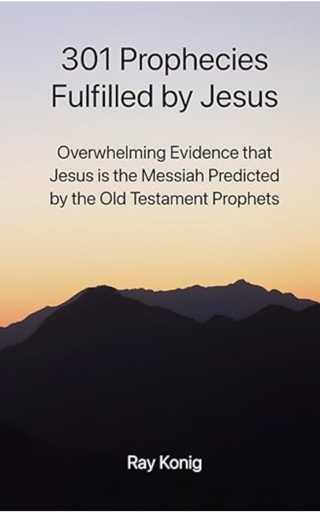
301 Prophecies Fulfilled by Jesus
This book is now available at amazon.com
Jesus remains the only person in history to have ever achieved or sustained a widespread following as being the Messiah who was promised by the prophets of the Old Testament.
This book, 301 Prophecies Fulfilled by Jesus, explains the reasons for this.
The prophets of the Old Testament predicted a savior, called the Messiah, an extraordinary individual who would offer forgiveness of sins and eternal life in the Kingdom of God.
Introduction
Of all the religious figures who have ever made it into the record of history, Jesus is far and away unique. He is the only one who fulfills more than 300 predictions that were recorded before he was born.
These prophecies, which are recorded in the Bible’s Old Testament, foretold of a savior, who is often called the Messiah or Christ. These terms are based, respectively, on the Hebrew and Greek words for anointed, as in anointed to be the savior of the world.
According to the prophecies, the savior would be born in Bethlehem during the time of the Second Temple, he would teach others about God’s offer of salvation, he would be rejected, he would suffer and die for the sins of others, and he would be resurrected. The prophets also foretold that he would be a Jew from the Israelite Tribe of Judah and that he would achieve a worldwide spiritual impact in which people throughout the world would become familiar with the God of Israel and his offer of salvation.
Collectively, these Old Testament prophecies foretold and foreshadowed details about the savior’s lineage, birth, nature, timing, life, ministry, rejection, persecution, death, resurrection, ascension and impact.
The Old Testament was written during a period of time that lasted about 1,000 years. It began with Moses about 3,400 years ago, and ended with Malachi about 2,400 years ago. Jesus was born about 2,000 years ago.
For background, the other part of the Bible is the New Testament, which was written about 2,000 years ago. It records Jesus’ lineage, birth, nature, timing, life, ministry, rejection, persecution, death, resurrection, ascension and impact.
The two main concerns of the Old Testament are the problem of sin, which separates people from God, and the promise of a savior, the Messiah, who would resolve the problem of sin. He would do this by living a sinless life and by offering himself as a sacrifice to atone for, as in pay for, the sins of others. He would become the ultimate atoning sacrifice so that all who believe in him are reconciled with God and will have eternal life in the Kingdom of Heaven.
Scholars have different ways of defining and counting the Old Testament prophecies that are about the Messiah. Common estimates range from about 100 to more than 300.
This book, 301 Prophecies Fulfilled by Jesus identifies and explains 301 Old Testament prophecies that are fulfilled by Jesus. The prophecies are listed and explained in the same chronological order in which they appear in the Old Testament, beginning with the prophecies from the book of Genesis, which was written about 3,400 years ago, and ending with the prophecies in the book of Malachi, which was written about 2,400 years ago.
This book will give the reader 301 reasons to understand why Jesus is the only person in history to have ever achieved or sustained a widespread following as being the answer to the Messianic prophecies of the Old Testament.
The reason for this book
There are many resources, including books and websites, that offer lists of Old Testament prophecies about a promised Messiah that are fulfilled by Jesus in the New Testament.
These lists, which show anywhere from a handful to hundreds of prophecies, vary greatly in terms of their quality. Very often, these lists can be confusing or underwhelming to people who are new to the study of Bible prophecy.
That is why this book, 301 Prophecies Fulfilled by Jesus, by Ray Konig, exists. This book seeks to do a better job of identifying, clarifying and explaining each of these prophecies -- in a way that will make sense to readers who are new to the topic of Bible prophecy.
This book strives to offer the very best list of Messianic prophecies that the reader has ever seen.
Bible study materials for this book can be accessed at: https://www.zealization.com.
This book is different
This book, 301 Prophecies Fulfilled by Jesus, by Ray Konig, is different than other books about the Messianic prophecies of the Bible. This book introduces the reader to the many connections, classifications and corroborations that exist among the Old Testament’s Messianic prophecies.
This book recognizes, acknowledges and understands that many Old Testament prophecies about the Messiah share connections with each other, that they can be grouped into categories, and that they work together to clarify and amplify important details about the promised Messiah.
To give an example, there are more than a dozen prophecies that can be classified as son of David prophecies, as in prophecies that revealed that the Messiah would be a son born to the House of David, and that he would be an extraordinary descendant of David, who was ancient Israel’s greatest king.
Also, there are more than a dozen prophecies that can be classified as worldwide spiritual impact prophecies. These prophecies foretold that the Messiah would affect people in every part of the world, and that people throughout the world would become familiar with the God of the Bible, as well as with his offer of salvation and eternal life in the Kingdom of Heaven.
And there are other groupings of Messianic prophecies that can be classified as timing prophecies, seed or lineage prophecies, and preservation prophecies.
Scholars and other commentators, throughout the past 2,000 years, since the dawn of Christianity, have offered an uncountable number of valuable insights into Bible scripture. But, as a whole, their insights involving the specific topic of fulfilled Messianic prophecy has been underdeveloped and underwhelming.
For 2,000 years, scholars have overlooked and underplayed key connections that various Messianic prophecies share with other passages of the Old Testament. And they have overlooked and underplayed key connections that various Messianic prophecies share with one another. And they have overlooked and underplayed how Messianic prophecies work together to affirm, reaffirm and expand upon key details involving the Messiah and his mission.
For example, one could read a hundred randomly selected commentaries about Isaiah 7:14, which is the prophecy about the virgin birth of the Messiah, and not see any evidence that the authors realized that this prophecy shares connections with more than a dozen other son of David prophecies, which are prophecies that speak of the promised Messiah as being an extraordinary descendant of David.
In fact, one could read a hundred commentaries and not see any evidence that the authors were even aware of the presence of more than a dozen prophecies that speak of the Messiah as being an extraordinary descendant of David, or that these prophecies could have been grouped together and given a name or label, such as the son of David prophecies.
In fact, one could read hundreds of commentaries about Isaiah 7:14 and never realize that the prophecy is speaking of an alma, which is a Hebrew word in the underlying text that is expressly defined in Genesis 24:16-43 as referring a young woman, of marriageable age, who is a virgin, and who is destined to be married soon.
This critically important detail is critically important to understanding the broader prophecy in Isaiah 7:13-14. When a person recognizes, acknowledges and understands the defined meaning of this critically important word, alma, they can recognize, acknowledge and understand that Isaiah 7:13-14 is indeed a prophecy that the Messiah would be born to a virgin. Then they can begin to acknowledge, recognize and understand why the Messiah needed to be born of a virgin.
Instead, we, as people who were born in either the 20th or 21st Century, have inherited some 2,000 years of commentaries in which some scholars acknowledge that Isaiah 7:14 is a prophecy about the miraculous birth of the Messiah and other scholars claim that it is not. This 2,000-year-old conflict would not have been possible if past scholars and commentators recognized, acknowledged and understood how the Old Testament actually defines the Hebrew word alma.
And recognizing, acknowledging and understanding the definition of alma was never difficult. It was always present in the Old Testament, in Genesis 24:16-43. The definition of alma has been there since Moses wrote the book of Genesis about 3,400 years ago. And it has been there throughout the whole of Christianity’s existence, for the past 2,000 years.
And yet this critically important detail remained overlooked and underplayed for 2,000 years, during which time an uncountable number of scholars and other commentators have managed to under-inform, or misinform, generations of readers.
To give another example of the failures of past commentaries, one could read a hundred commentaries about Messianic prophecy and never see evidence that the authors realized that the prophets foretold -- repeatedly -- that the Messiah would have a worldwide impact. This is a very big detail to have overlooked. Its size is literally of global proportion.
Despite this past tendency to overlook important details, even those of global proportion, there actually are more than a dozen prophecies in the Old Testament that associated the promised Messiah with a predicted worldwide impact.
In fact, there are so many predictions about the Messiah having a worldwide impact that these prophecies can be grouped into separate classifications, such as those that foretold of a worldwide spiritual impact and those that foretold of a worldwide dominion.
One could read hundreds of past commentaries and never see any mention of categories like the ones introduced above or see any evidence that these scholars or commentators had any awareness of their existence.
Why is any of this important? Why do we need to care about recognizing, acknowledging and understanding key connections, classifications and corroborations that exist among the Old Testament’s Messianic prophecies?
Let’s answer that with a different scenario: Imagine being a patient with pneumonia and having a doctor who does not recognize, acknowledge or understand that pneumonia is an infection, or that it is an infection that affects the respiratory system, or that it could affect other systems if left untreated.
Imagine if this doctor provides no evidence that he or she even recognizes, acknowledges or understands that there is an infection, or that there is a respiratory system, or that the human body consists of many systems that work together to sustain a person. What value would this doctor have in advising his or her patient? Why would you continue relying on this doctor?
This example of a doctor who fails to recognize, acknowledge and understand key connections, classifications and corroborations is an accurate way to assess the past 2,000 years of Bible commentary in regard to the specific topic of Messianic prophecy.
One can read commentaries from hundreds of different scholars and never see evidence that these scholars were aware that there are “systems” of prophecies within the Old Testament, that they share connections with each other, that they can be grouped together into classifications, and that they corroborate each other to reaffirm and illuminate their meanings. And yet these connections have been there ever since the Old Testament was completed more than 2,400 years ago.
This book, 301 Prophecies Fulfilled by Jesus, is different. This book does not overlook or underplay critically important connections, classifications and corroborations that are present within the Old Testament prophecies about the Messiah. This book identifies them, introduces them to the reader, highlights them, and explains them.
By recognizing, acknowledging and applying the many connections, classifications and corroborations that exist among the Messianic prophecies, readers have the opportunity to gain a fuller understanding of these prophecies. And that puts them in a stronger position to recognize, acknowledge and understand that Jesus is the Messiah who was promised by the prophets of the Old Testament.
The approach of this book
Every major detail involving Jesus was either foretold or foreshadowed by the prophets of the Old Testament. This book, 301 Prophecies Fulfilled by Jesus, by Ray Konig, provides the reader with a selection of 301 succinctly explained examples.
These prophecies foretold or foreshadowed details about the lineage, birth, nature, timing, life, ministry, rejection, persecution, death, resurrection, ascension and impact of Jesus, showing that he is the Messiah who was promised by the prophets. Some prophecies introduce new details while others repeat previously revealed details, highlighting the importance of those details.
Each of the 301 prophecies are listed in the order in which they appear in the Old Testament. And each are explained in three sections: prophecy, summary, and fulfillment.
The prophecy section will show the Old Testament prophecy, using the World English Bible, or WEB, translation.
The summary section will explain how the prophecy works and identify which detail is being foretold or foreshadowed.
The fulfillment section will explain how Jesus fulfills that prophecy.
The goal is to provide the essential information so that the reader can understand how the prophecy works and how it is fulfilled by Jesus.
Overview of Messianic prophecy in the Old Testament
Scholars have different ways of defining and counting the Old Testament prophecies about the Messiah. Many of their estimates range from about 100 to more than 300.
This book, 301 Prophecies Fulfilled by Jesus, by Ray Konig, identifies and explains 301 examples of prophecies that foretold or foreshadowed important details that later were fulfilled by Jesus as the Messiah.
The prophecies of the Old Testament identify and confirm that Jesus is the Messiah just as surely as the pages of history identify and confirm that Jesus is the only person who has ever achieved or sustained a widespread following as being the Messiah who was promised by the Old Testament.
The Old Testament prophets used a variety of terms when speaking of the promised Messiah, including he, seed, branch, servant, redeemer, king, and anointed one.
At some point during ancient times, the people of Israel began using the word Messiah as a convenient way to refer to the savior who was being promised by the prophets of the Old Testament.
For background, the English terms Messiah and Christ come from the Hebrew and Greek words for anointed, as in anointed to be the savior of the world. The languages of Hebrew and Greek, as well as Aramaic, were used in Israel during the time of Jesus.
Some of the Messianic prophecies of the Old Testament are predictive and some set a precedent. Both types are important.
The predictive prophecies foretold important details about the Messiah, including that he would be an Israelite (Genesis 28:14), from the Tribe of Judah (Genesis 49:10), from the House of David (2 Samuel 7:12-16), and that he would be born in Bethlehem (Micah 5:2), during the time of the Second Temple (Daniel 9:24-27).
Predictive prophecies helped people during ancient times to anticipate the Messiah and identify him once he arrived. And they allow people in modern times to look back through the pages of the Old Testament to confirm that Jesus is the Messiah who was promised.
The precedent prophecies work differently. They establish an Old Testament precedent, or template, for the Messiah. For example, the near-sacrifice of Isaac in the Old Testament foreshadows important details, and offers important parallels, involving the sacrifice of Jesus in the New Testament.
There are many precedents within the events, laws and ceremonies of the Old Testament that not only point to the Messiah but help to explain key aspects of his mission and purpose. Collectively, these precedents help to show that Jesus fulfills the whole of the Old Testament, not just its predictive Messianic prophecies.
The Old Testament was written from the time of Moses, which is about 3,400 years ago, through the time of Malachi, which is about 2,400 years ago. The writing of the Old Testament took about 1,000 years, ending about 400 years before Jesus was born.
There are 39 books in the Old Testament: Genesis, Exodus, Leviticus, Numbers, Deuteronomy, Joshua, Judges, Ruth, 1 Samuel, 2 Samuel, 1 Kings, 2 Kings, 1 Chronicles, 2 Chronicles, Ezra, Nehemiah, Ester, Job, Psalms, Proverbs, Ecclesiastes, Song of Solomon, Isaiah, Jeremiah, Lamentations, Ezekiel, Daniel, Hosea, Joel, Amos, Obadiah, Jonah, Micah, Nahum, Habakkuk, Zephaniah, Haggai, Zechariah, and Malachi.
Sixteen of these books are named after prophets and many of the other books also contain prophecies.
The Bible also has a New Testament, which explains the life, death, resurrection and teachings of Jesus. It also explains how Jesus is the fulfillment of the Old Testament.
There are 27 books in the New Testament: Matthew, Mark, Luke, John, Acts, Romans, 1 Corinthians, 2 Corinthians, Galatians, Ephesians, Philippians, Colossians, 1 Thessalonians, 2 Thessalonians, 1 Timothy, 2 Timothy, Titus, Philemon, Hebrews, James, 1 Peter, 2 Peter, 1 John, 2 John, 3 John, Jude, and Revelation.
Collectively, from the books of the Old Testament, we receive more than 300 prophecies about a promised savior, foretelling and foreshadowing details about his lineage, birth, nature, timing, life, ministry, rejection, persecution, death, resurrection, ascension and impact.
Jesus is unique in this regard. There is no other religious figure or person who has ever been the subject of so many prophecies. In fact, outside of the Bible, it would be difficult to find a single person who could plausibly claim to be the fulfillment of even one prophecy.
And Jesus remains the only person to have ever achieved or sustained a widespread following as being the answer to the prophecies of the Old Testament. This book, 301 Prophecies Fulfilled by Jesus, explains why this is true.
To see a summary list of the 301 prophecies that Jesus fulfills, please click this link for the article The list: 301 Prophecies Fulfilled by Jesus.